







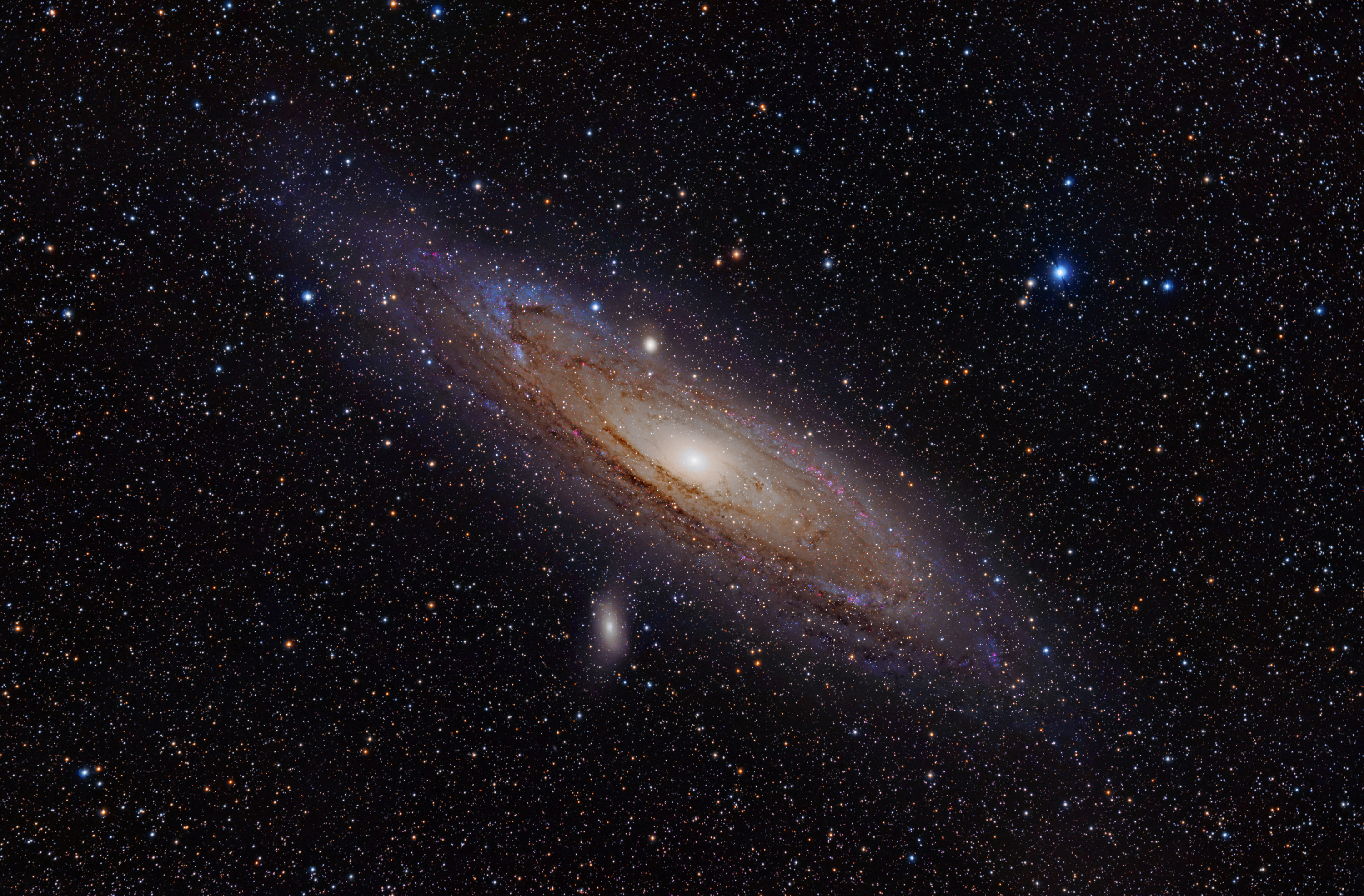
For the first time in the history of astronomy, scientists have watched a giant star swallow its smaller companion whole, following the entire catastrophic collision from its first warning signs to its fiery end. The event, which played out 2.5 million light-years away in the neighbouring Andromeda galaxy, has given researchers their clearest ever view of one of the most dramatic processes in the life of stars, and Indian institutions played a central role in the discovery.

The findings, published in the journal Nature on November 18, describe an event designated AT 2025abao, a luminous red nova in which a bloated red giant star, nicknamed "Big Bao", engulfed its smaller partner, "Small Bao", after a slow, seven-year spiral into its core.
The research was led by scientists at Columbia University in the United States, and included researchers from Indian institutions: the Indian Institute of Astrophysics, the Indian Institute of Technology Bombay and Pondicherry University.
An international team of astronomers witnessed the collision, capturing the entire lifecycle of the event from start to finish. While astronomers have previously observed stellar collisions after they erupted, this is the first time they have watched the warning signs build over years before catching the final embrace, and the first time they have been able to measure the forces at work throughout the process.
The encounter involved a bloated giant star roughly seven times heavier than our Sun, nicknamed "Big Bao" after the eruption's name. At its largest, the star had swollen to 350 times the radius of the Sun and was 18,000 times brighter. Its partner, "Small Bao", was slightly smaller than the Sun, with about 70 per cent of its mass.
Toward the end of their lives, stars exhaust the fuel at their centres and swell into gigantic, diffuse spheres called red giants. As Big Bao puffed up to hundreds of times its original size, it trapped Small Bao inside its sprawling atmosphere. The two stars ended up sharing a single outer envelope of hot gas, a stage astronomers call common envelope evolution.
Trapped within this common cloak of hot gas, the smaller star experienced the enormous gravitational pull of its neighbour, causing it to spiral inward for seven years before crashing into the giant's dense core. The manoeuvre lasted fewer than ten orbits and blasted 10 per cent of the giant's outer layers into deep space.
The story of the discovery began long before the final explosion. Digging into archival survey plates, the astronomers found that the star had slumbered quietly for thirty years before beginning an ominous, gradual brightening in 2018.
In 2023, Viraj Karambelkar, a Hubble Fellow at Columbia University and the lead author of the new study, and his colleague Kishalay De, then at the Massachusetts Institute of Technology, noticed the steady brightening of a star in the Andromeda galaxy.
"Steady brightening was unusual, but even if something was stirring, no one expected to see an explosion in their lifetime, as these stars remain relatively stable for thousands of years," Karambelkar said.
In May 2025, Karambelkar and De published a paper proposing that the brightening star was a red giant that had started to engulf its smaller companion. They had not yet seen the companion directly, but the slow brightening suggested that, as the red giant expanded, it had begun to swallow its partner. By mid-July 2025, when NASA's SPHEREx mission imaged the system, the already colossal primary star had more than doubled in size again.
Then, on October 17, 2025, an amateur astronomer detected an unexpectedly brilliant flash on the fringes of the Andromeda galaxy. The Zwicky Transient Facility, a survey telescope at Caltech's Palomar Observatory in California, also spotted the eruption. Within hours, researchers around the world swung an armada of ground and space instruments toward the target.
The teams tapped the Zwicky Transient Facility and the WINTER infrared survey telescope at Palomar, joined by spectroscopic instruments at the W. M. Keck Observatory, the Gemini North telescope on Mauna Kea in Hawaii, the Neil Gehrels Swift Observatory, and NASA's space-borne SPHEREx and James Webb Space Telescopes.
Data captured by the James Webb Space Telescope just 47 days after the eruption, and again in December 2025, caught dust forming in the cooling, out-flowing cloud of gas.
"We were able to see all different phases of this process, we were able to see the quiescent system, we were able to see the moment the stars touched each other, we were able to see the inspiral, and we were able to see the big outburst in 2025," Karambelkar said.
The physics of the collision is as violent as it is revealing. As Small Bao ploughed through Big Bao's fluffy outer layers, friction stripped the smaller star of its orbital momentum. The friction generated intense heat, which convection carried up to the surface and radiated away, creating a steady, multi-year glow. When the companion star sank too deep, the gentle heating abruptly turned into an uncontrolled plunge.
The smaller star slammed into the giant's helium core, releasing vast amounts of gravitational energy that drove a shockwave outwards, hurtling debris into surrounding rings of gas at blistering speeds of up to 900 kilometres per second.
The merger occurred when the red giant dragged its companion into its core, an event that study co-author Kishalay De, now an assistant professor of astronomy at Columbia University, described as being like "a bomb exploding inside a living star".
What makes this observation so valuable is that earlier observations of colliding stars involved relatively compact stars that spewed blinding clouds of gas early on, masking the delicate initial spiral. Because Big Bao is a puffy red giant with a loosely bound convective atmosphere, it allowed astronomers to directly measure the drag forces and heat transfer predicted by textbook astrophysics for more than fifty years.
The findings provide the first real-world calibration for the theoretical energy equations used to explain how binary stars contract into compact pairs. The observations confirm theorists' ideas about how such stellar mergers should happen, and suggest that convection helps transport energy outward toward the giant star's surface.
Jason Nordhaus of the Rochester Institute of Technology, who wrote a perspective piece in the same issue of Nature, noted that the observations confirmed the theoretical picture.
Most stars in the universe travel in pairs, bound by mutual gravity. When one star swells into a red giant, the two objects can end up sharing a single outer atmosphere, and the outcome of that shared envelope phase determines the fate of the pair. Some pairs spiral together and merge, as Big Bao and Small Bao did.
Others eject the shared envelope and emerge as a tight binary of two compact stars, which may later produce phenomena such as gravitational waves. Understanding this phase is therefore central to understanding how many of the most energetic events in the universe come about.
The coordinated observations across dozens of global facilities also demonstrate international scientific collaboration at its finest. Mansi Kasliwal, a co-author of the study, professor of astronomy at Caltech and director of the Palomar Observatory, explained how the rapid response was organised. "For more than a decade, we have built a well-oiled machine for systematic scanning and automated follow-up observations of the dynamic optical and infrared universe. This helps us to be very efficient as soon as we receive alerts. Combining our data with data from other global facilities helped us build a uniquely detailed picture of the AT2025abao system and confirm that a small star had crashed into the core of its larger companion," she said.
The Indian contribution to the discovery was substantial. Professor Varun Bhalerao of IIT Bombay, a co-author of the study, wrote on X: "We've seen a few before, but this one, we saw it evolve over years, from start to the end. Our team contributed observations in the months of peak drama." The Indian Institute of Astrophysics and Pondicherry University also contributed researchers to the international team.
Although all signs point to Small Bao being entirely obliterated within the core, the scientists emphasise that only decades of future telescope monitoring will conclusively rule out whether a stripped stellar remnant survived deep within the newborn giant.
The discovery also carries a quiet warning about the fate of our own solar system. The Sun, like Big Bao, will one day exhaust its central fuel and swell into a red giant. Whether it will engulf the Earth in the process is a question astronomers have debated for decades. The observation of AT 2025abao does not answer that question directly, but it shows, for the first time, exactly how such an engulfment unfolds, step by step, over years rather than in a single instant.
For the astronomers involved, the event was a once-in-a-lifetime observation. They had watched a star brighten slowly for years, predicted that it was swallowing its companion, and then seen the prediction confirmed in a brilliant flash that lit up the Andromeda galaxy.
(Reporting based on Research Matters and Smithsonian Magazine.)