







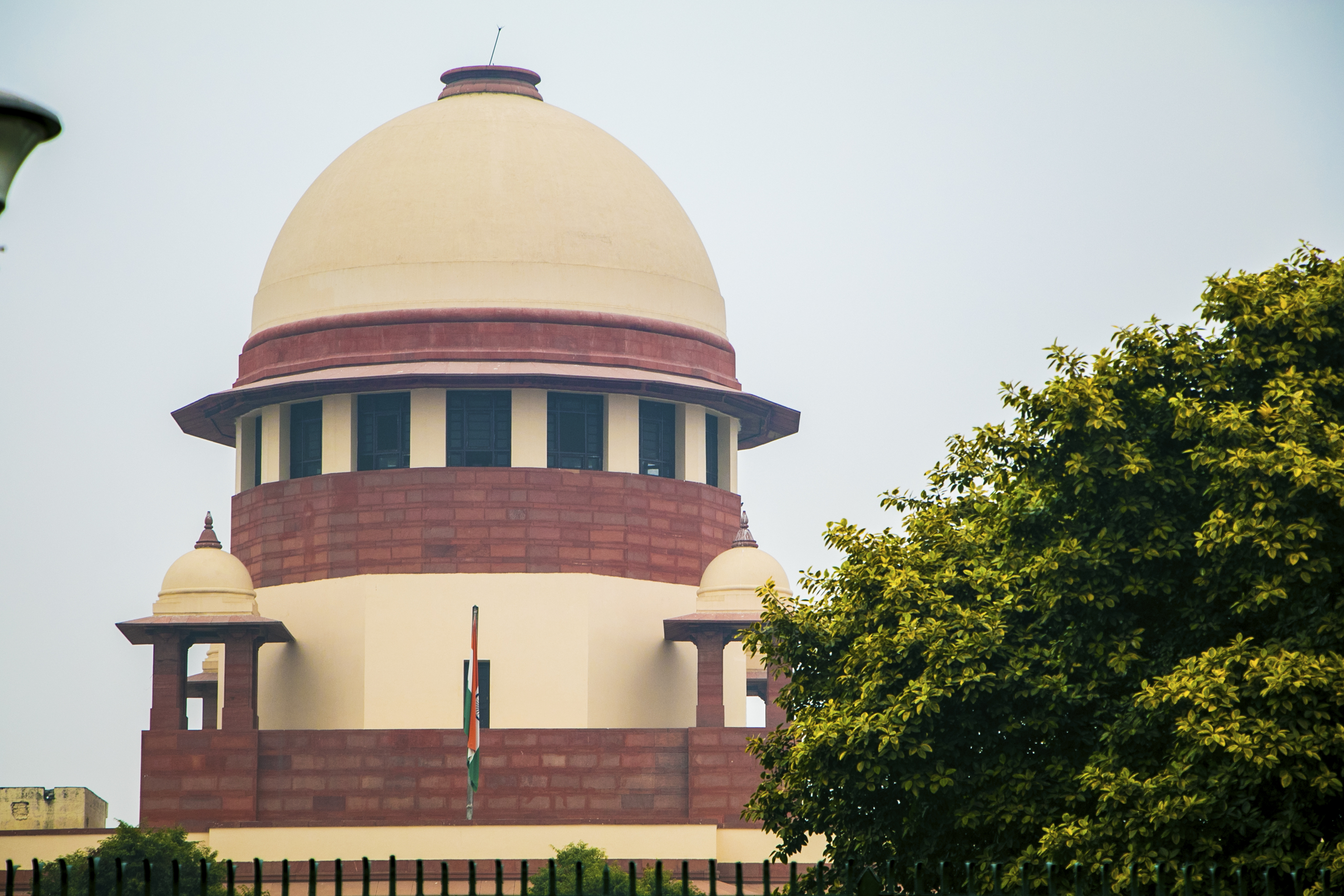
The Supreme Court on Wednesday refused to stay the interim bail granted to Samajwadi Party leader Azam Khan by the Allahabad High Court in a money laundering case, declining the Enforcement Directorate's urgent plea to keep the 78-year-old politician in custody. The court agreed to hear the agency's challenge on Thursday, November 19, but made it clear that Khan would remain free on interim bail until then.

"Heavens will not fall, let him be on interim bail," Justice Joymalya Bagchi said, turning down the Enforcement Directorate's oral plea for a stay. The remark came during an urgent mentioning of the matter before a bench headed by Chief Justice of India Surya Kant, which also included Justices Joymalya Bagchi and V Mohana.
Additional Solicitor General SV Raju, appearing for the Enforcement Directorate, had orally mentioned the matter before the Chief Justice seeking an urgent hearing on Wednesday itself. The agency has approached the Supreme Court challenging the interim bail granted to Khan by the Allahabad High Court a day earlier, on Tuesday, November 17, in a money laundering case linked to the Maulana Mohammad Ali Jauhar Trust and the Mohammad Ali Jauhar University in Rampur.
Raju objected to the High Court's prima facie observation that Khan's arrest appeared to be mala fide, and asked whether such a finding could be made without making the officer concerned a party to the proceedings. He argued that the interim bail order had been passed in haste and without giving the agency adequate opportunity to present its case.
"The order was passed hastily. We did not even have time to file a full reply. This happened on the first day of hearing," the Additional Solicitor General told the court, adding that the interim order was in the nature of a final order. He asserted that the grounds of arrest had been attempted to be served on Azam Khan but that he had refused to accept them.
When Chief Justice Surya Kant agreed to list the matter for hearing on Thursday, Raju sought an order of status quo, saying that Khan would otherwise be released from custody. The bench, however, declined the oral plea for status quo. "No. Not today. You argue all these points before the court concerned tomorrow," the Chief Justice said, according to reports of the proceedings.
The Enforcement Directorate had arrested Khan on October 31, right outside the jail gates, moments after he came out after securing bail in another case, a dual PAN card case. Khan challenged his arrest on the ground that it had been carried out without following the mandatory procedure laid down by law.
The Allahabad High Court, while granting interim bail on Tuesday, observed that the Enforcement Directorate had not strictly followed the mandate of Article 22(1) of the Constitution while carrying out the arrest. The provision requires that a person who is arrested be informed, as soon as may be, of the grounds for the arrest.
The High Court prima facie observed that the arrest appeared to be "mala fide" and "motivated", and also noted that the agency had failed to furnish written grounds of arrest when it took Khan into custody on October 31.
The High Court has given the Enforcement Directorate one week to file its counter-affidavit and Khan ten days to submit his response. The matter before the High Court is scheduled to come up again for further hearing on December 10.
The money laundering case stems from alleged financial irregularities connected to the Maulana Mohammad Ali Jauhar Trust, founded and controlled by Khan, and the building of Mohammad Ali Jauhar University in Rampur. The Enforcement Directorate's investigation centres on alleged financial misuse and illegal land deals linked to the trust and the university.
Khan, a senior Samajwadi Party leader and former minister in the Uttar Pradesh government, has faced a series of criminal cases over the years, and his legal battles have been closely followed in the state. The latest round began with his arrest on October 31, which came within minutes of his release on bail in the dual PAN card case, a sequence of events that has itself become a central part of the legal dispute.
The Supreme Court had earlier directed Khan to pursue his remedy before the High Court, and the transferred petition was heard there on November 16. The High Court's interim bail order on November 17 set the stage for the Enforcement Directorate's urgent approach to the Supreme Court the following day.
The agency's challenge to the interim bail order will now be examined in detail at Thursday's hearing, when the court will hear the Enforcement Directorate's arguments on the merits of its appeal. Until then, the interim bail order stands, and Khan remains free. The Supreme Court's refusal to grant an immediate stay means that the agency's apprehension that Khan would walk out of jail has, for the moment, been set aside by the court.
The case is significant not only for Khan but also for the wider questions it raises about arrest procedures under the Prevention of Money Laundering Act. The High Court's observations on Article 22(1) and on the need to furnish written grounds of arrest go to the heart of the safeguards that the law provides to a person taken into custody, and the Supreme Court's eventual view on those questions will be watched closely by lawyers and enforcement agencies alike.
For now, the immediate outcome is clear: the Supreme Court has refused to intervene at this stage, and the Enforcement Directorate will have to make its case at the hearing on Thursday. The court's message, delivered in Justice Bagchi's words, was that there was no urgency requiring it to stop Khan from remaining on interim bail until the matter was properly heard.
The hearing on Thursday will determine how the Enforcement Directorate's challenge to the interim bail order proceeds, and whether the Supreme Court finds merit in the agency's argument that the High Court acted in haste. Whatever the outcome, the case has already produced one of the more memorable exchanges in the courtroom in recent times, with the bench's refusal to grant a stay summed up in a single line that is likely to be quoted well beyond this case.
(Reporting based on Live Law and The Times of India.)