







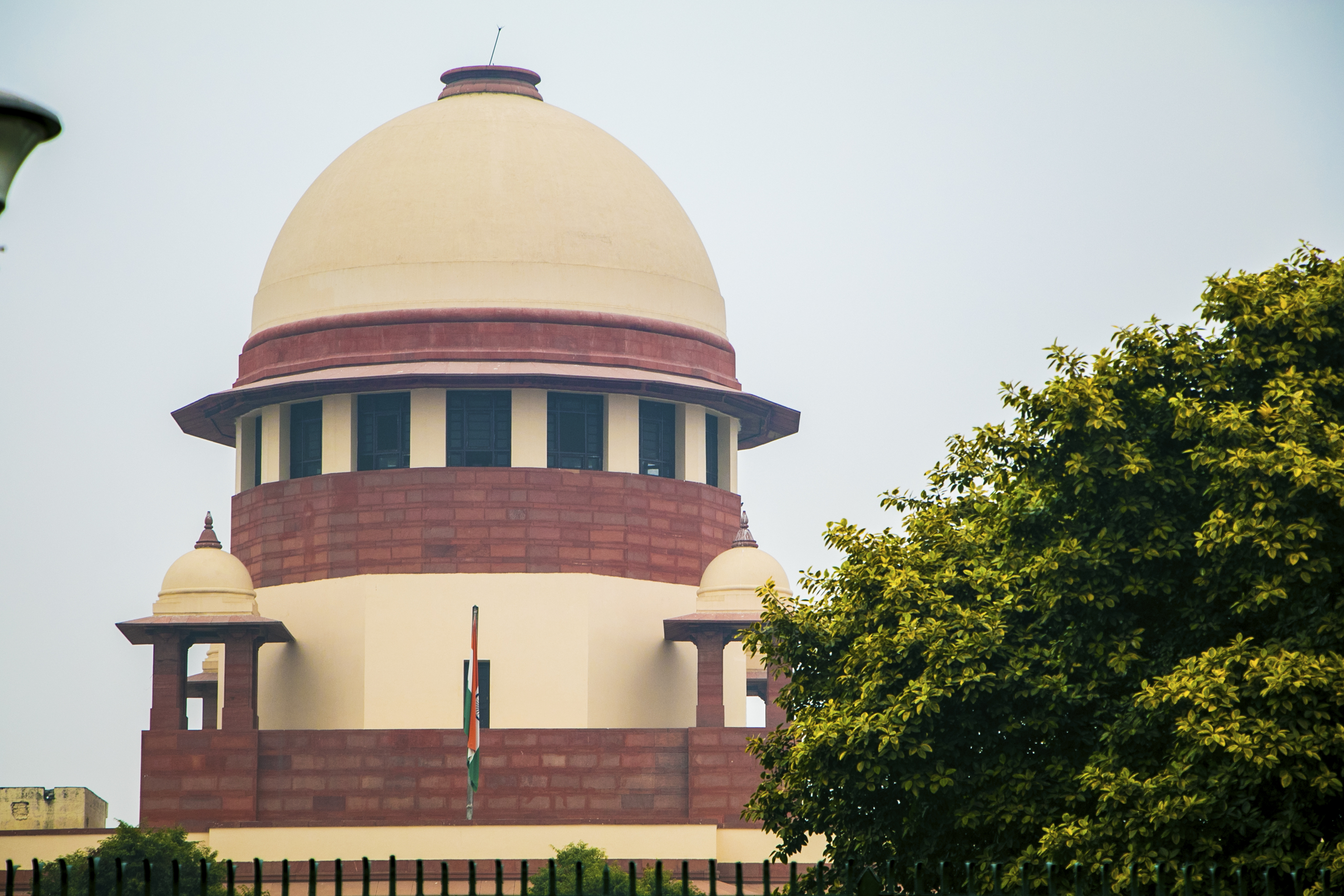
The Supreme Court on Thursday ruled that the 24-hour period within which an arrested person must be produced before a magistrate begins from the moment of detention, when a person's liberty is curtailed, and not from the time the police formally record the arrest. The ruling closes a loophole that investigating agencies have long used to hold people for questioning without the protection of judicial oversight, and it lays down new duties for magistrates across the country.

A bench of Justices Ujjal Bhuyan and Atul S Chandurkar held that any artificial distinction between "arrest" and "detention" is constitutionally unsustainable. "The view that 24 hours begin only from the formal arrest is contrary to the constitutional mandate of Article 22(2) and Section 56 of BNSS," the bench ruled.
Article 22(2) of the Constitution requires that every person who is arrested and detained in custody be produced before the nearest magistrate within 24 hours, excluding only the time necessary for the journey from the place of arrest to the court. The Bharatiya Nagarik Suraksha Sanhita, 2023, which replaced the Code of Criminal Procedure, carries the same safeguard.
The court was emphatic that the Constitution does not permit investigating agencies to create a buffer period of detention before the clock starts. "Article 22(2) does not sanction exclusion of the time taken for inquiry or investigation before the arresting authority could effect arrest of the detainee. This is beyond the mandate of clause (2) of Article 22. The only exception the Constitution itself provides is the time necessary for the journey from the place of arrest to the court of the magistrate," the court said.
It added that the idea that the 24 hours begin only after a search and seizure is completed and the arrest is formally recorded "is not only unsustainable in law but is entirely unconstitutional."
The ruling came in a case that showed exactly how the loophole worked in practice. The court was deciding appeals filed by four persons challenging the Tripura High Court's decision to deny them bail in a case under the Narcotic Drugs and Psychotropic Substances Act. The case involved the seizure of 11.03 kilograms of yaba tablets, a form of methamphetamine.
The four men were detained on September 29, 2025, at 2 pm as part of a search and seizure operation, but they were shown as formally arrested only at 11 am on September 30, 2025. The court ruled that they ought to have been produced before a magistrate within 24 hours from September 29 at 2 pm, the moment their liberty was curtailed.
The court noted that the men had been kept under detention for about 18 hours without any judicial oversight. Holding that this violated Article 22(2), it ordered their immediate release. The case is Sujit Das v. Union of India, and Senior Advocate Rauf Rahim, assisted by Ali Asghar Rahim, appeared for the appellants in the Supreme Court.
Justice Bhuyan, pronouncing the judgment, laid down seven conclusions that will now govern how the 24-hour rule is applied. First, the period of 24 hours for production before a magistrate under Article 22 commences from the date and time of detention of the person detained, when his liberty stands curtailed, and not from the time of his formal arrest.
Second, if detention continues beyond 24 hours before the person is produced before a magistrate, he shall be forthwith released from custody. Third, while computing the 24-hour deadline, no other period may be excluded except the time necessary for the journey from the place of arrest to the court of the magistrate.
Fourth, the decisions of the Orissa High Court in Aryaman Pattanaik, the Madras High Court in Kannan and the Kerala High Court in Arun K Thomas, which had held that the pre-arrest detention period can be excluded from the 24 hours, do not lay down the correct law on the interpretation of Article 22(2).
Fifth, the detaining authority should keep in mind not only the 24-hour deadline mandated by Article 22(2) but also ensure that detention does not extend beyond a reasonable period within those 24 hours, considering the circumstances of the case, in terms of Section 58 of the BNSS.
Sixth, at the time of production, the magistrate is duty-bound to record the actual date and time of detention of the person produced before him, when his liberty stood curtailed, and to examine whether the 24-hour deadline has been complied with from the time of such detention. If there is a breach, the person shall be forthwith released.
Seventh, the magistrate shall also examine whether the detention, though within 24 hours, has exceeded a period that can be considered reasonable in the circumstances. If satisfied that the custody has lasted longer than reasonable, the magistrate may decline remand.
The reasoning behind the ruling goes to the heart of what Article 22(2) means. The court noted that the provision uses the expression "every person who is arrested and detained in custody", and held that the words "arrested" and "detained" are joint and conjunctive, meaning one and the same thing. "This is because the Constitution does not recognise any detention divorced from arrest," the court said.
It disagreed with the view that detention for a brief period is not an arrest, holding that there cannot be any temporary suspension of a fundamental right.
The court also pointed to the practical problem with allowing a distinction. "An artificial distinction between 'arrest' and 'detention' would be highly problematic. If we venture into such semantics, the question will naturally arise as to who will determine what a short investigative period is or when a detention extends beyond the short investigative period," the court asked.
In other words, once the police are allowed to define a period of detention as something other than arrest, there is no principled limit to how long that period can last.
The court approved the view taken by the Kerala High Court in Biswajith Mandal, which had held that the 24-hour deadline begins from the moment a person's liberty is effectively curtailed, rather than from the time the police formally record the arrest. At the same time, it disapproved the contrary views taken by the Orissa, Kerala and Madras High Courts, holding that they did not lay down the correct law under Article 22(2).
The judgment therefore settles a conflict between different high courts that had left the law uncertain for years.
The court also linked the ruling to the wider problem of custodial abuse, observing that instances of custodial violence make proper judicial oversight of detention necessary. The 24-hour rule exists precisely so that a person taken into custody is brought before an independent judicial authority quickly, giving the magistrate a chance to check whether the detention is lawful, whether the person has been treated properly, and whether continued custody is justified.
When the clock is allowed to start only at formal arrest, that oversight arrives late, or not at all.
The background of the case adds another dimension. The Tripura High Court had denied bail to the four accused, holding that the stringent twin conditions under Section 37 of the NDPS Act must be satisfied before bail can be granted in cases involving commercial quantities of contraband. The High Court had relied on the Supreme Court's recent judgment in State of Punjab v.
Sukhwinder Singh, which held that prolonged incarceration alone cannot override the statutory restrictions on bail under the NDPS Act. The Supreme Court's ruling on Thursday does not disturb that bail framework, but it holds that even in such cases, the constitutional protection of Article 22(2) cannot be sidestepped by delaying the formal recording of arrest.
What changes on the ground from Thursday is significant. Police and other investigating agencies will now have to record the actual time at which a person's liberty is curtailed, and they will have to produce the person before a magistrate within 24 hours of that moment. They can no longer spend hours questioning a person and then start the clock when they choose to write down the arrest.
Magistrates, for their part, will have to ask when the person was actually detained, record that time, and check compliance for themselves. If the deadline has been breached, they must order release. If the detention, even within 24 hours, has gone on longer than reasonable, they may refuse remand.
For lawyers and civil liberties groups, the judgment is a welcome reaffirmation of a constitutional safeguard that is often honoured more in form than in substance. For investigating agencies, it is a warning that the paperwork of arrest cannot be used to buy extra hours of custody.
And for every person picked up by the police, it means that the protection of Article 22(2) now begins at the moment the police take away their freedom, not at the moment the police decide to admit that they have done so.
(Reporting based on Live Law, Deccan Herald and LawTrend.)