







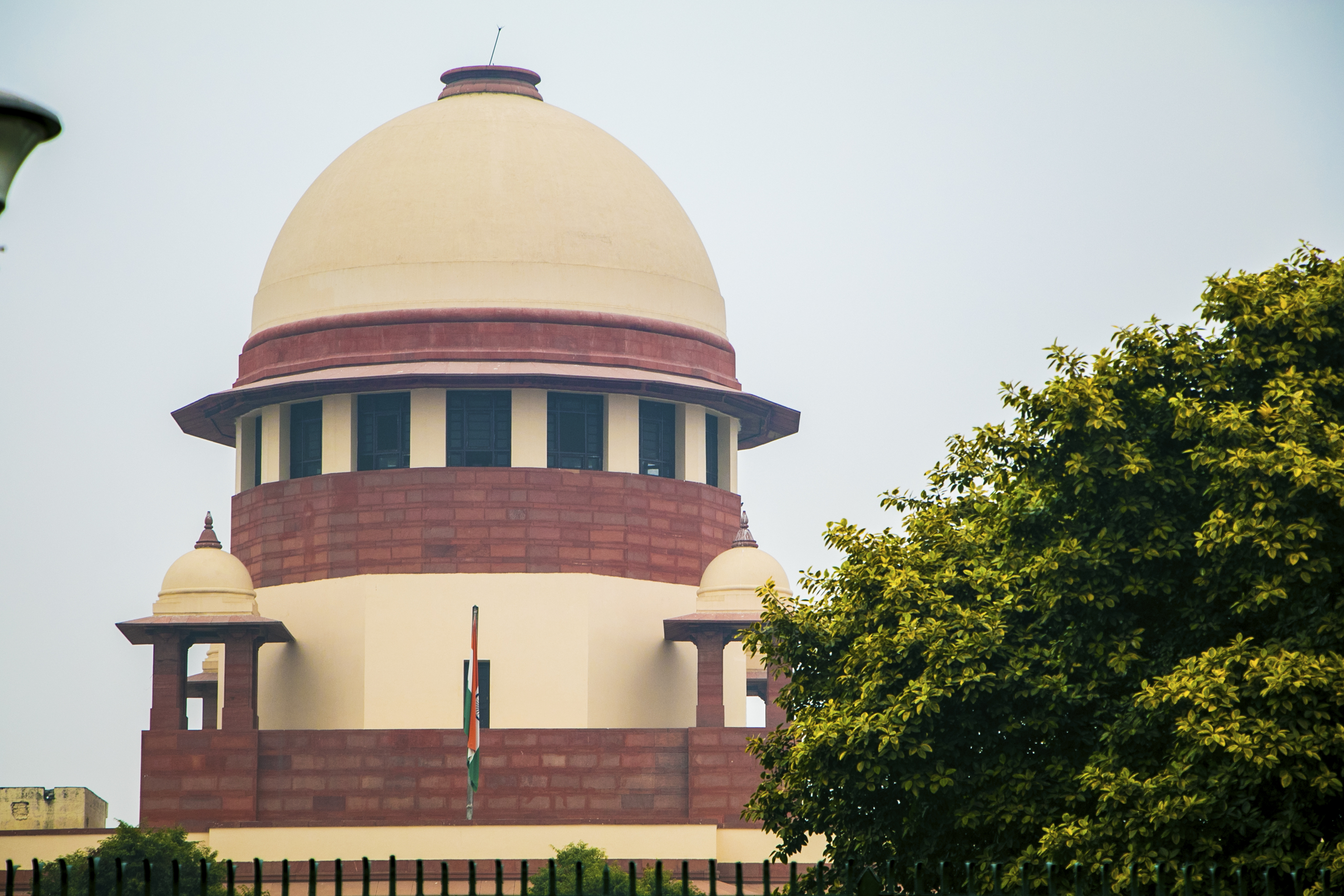
The Supreme Court on Tuesday issued notice to the Union government on a petition filed by the digital arms of 21 of India's best-known news organisations, which have challenged key provisions of the country's data protection law on the ground that they threaten press freedom and could force newsrooms to shut down. The court, however, declined to stay the law for now, saying it would not pass an order without hearing the other side.

A bench comprising Chief Justice of India Surya Kant and Justices Joymalya Bagchi and V Mohana issued the notice after hearing senior advocate Madhavi Divan, who appeared for the Digital News Publishers Association (DNPA). The matter will be heard next on November 17, along with other pending petitions concerning the law.
The DNPA describes itself as an organisation of the digital wings of major news organisations, including The Indian Express, The Hindu, India Today, the Times Group, Zee, NDTV and Network 18. Its petition, filed under Article 32 of the Constitution, seeks to declare several provisions of the Digital Personal Data Protection Act, 2023 unconstitutional. The challenged provisions are Sections 7, 17(2), 18, 19, 27, 29, 36, 37 and 44(3) of the Act.
The petition also challenges Rules 16, 17 and 23 of the Digital Personal Data Protection Rules, 2025. An independent investigative journalist based in New Delhi, Yukta Mudgal, is also a petitioner in the case.
At the heart of the challenge is a simple but far-reaching argument: the law, as it stands, contains no exemption for journalism. That means news organisations would have to treat the personal data they handle in the course of reporting in much the same way as any other entity that processes personal data, including seeking consent from the individuals concerned before publishing.
The petitioners say this requirement is unworkable for journalism, which by its nature deals with information about people who may not wish to be reported on, and often cannot be reported on at all if their consent is required first.
Divan told the court that the provisions would, in effect, shut down the newsroom. She described the petition as the first comprehensive challenge to the law by what she called legacy media. "We are the traditional, conventional legacy media," she submitted.
"This will change the whole concept of news. If I am left to the mercy of the data principal on whether he or she will give consent, the concept of news will be gone. News has to be new. It will close down the newsroom. What is the point if I have to ask for permission and consent?"
The argument extends beyond print and digital text. Divan warned that the consent requirements could affect live television coverage and restrict newsrooms from reporting without prior permission, and that time-sensitive reporting would be particularly hard hit.
She also contended that the media is already regulated by bodies such as the Press Council, and that inaccurate reporting must face consequences, but that prior permission cannot be insisted upon as a condition for publishing.
The bench was sympathetic to the concerns but firm on procedure. It refused to grant an interim stay of the challenged provisions. "We are not going to pass an ex parte order without hearing the other side," the bench told Divan.
"You have to tell us how you are going to regulate yourself." The Chief Justice observed that a balance must be struck between press freedom and individual rights, and added that the petitioners, as domain experts, were well placed to suggest safeguards. "You are the domain experts. You are the best person to suggest to the Union and us how you will ensure there is no misuse," he said.
The court also asked how the petitioners would ensure that people's rights are not abused in the course of reporting.
The petition characterises the challenged provisions as a form of pre-censorship, a phrase that has featured prominently in the debate around the law. According to the petitioners, the absence of a journalistic exemption would render investigative journalism a benign and neutered recorder of events, because reporters would be unable to pursue stories involving individuals who withhold consent, and sources could be exposed through the law's machinery.
Reports on the petition have noted that the 21 publishers include companies owned by industrialists Mukesh Ambani and Gautam Adani.
The challenge did not arrive in a vacuum. The Digital Personal Data Protection Act was passed in 2023, and its accompanying rules were notified on November 15 last year. Even before the rules were notified, journalist bodies had raised objections.
The DIGIPUB News India Foundation, a body of digital news organisations, had said the Act and the Rules endanger source confidentiality, hinder public-interest investigations and obstruct anti-corruption disclosures.
It had also objected to the removal of the journalistic carve-out from the law, and highlighted that Section 44(3) of the Act substitutes Section 8(1)(j) of the Right to Information Act, thereby abolishing the public-interest override that previously allowed disclosure of personal information where a larger public interest was involved. That change, DIGIPUB argued, makes access to information even more restrictive.
The Editors Guild of India has also warned that without an explicit exemption, journalism risks being treated as personal data processing that requires consent, thereby chilling newsgathering and hindering accountability journalism. The concern is not abstract. Much of investigative reporting depends on publishing information about powerful individuals and institutions that would rarely consent to scrutiny.
If every such publication required prior consent, the argument goes, the stories that matter most would be the ones least likely to appear.
The government's position, which the court will hear in detail at the next hearing, rests on the other side of the same balance. The data protection law was enacted to give individuals control over their personal data in an age when digital platforms collect, store and use such data at enormous scale.
Its supporters argue that strong consent requirements and obligations on those who process data are necessary to protect privacy, prevent misuse and give citizens enforceable rights over their information. From this perspective, broad exemptions could become loopholes through which privacy protections are weakened.
What the court ultimately decides will shape the relationship between two constitutional values that are often in tension: the freedom of the press and the right to privacy. The Supreme Court has in the past recognised privacy as a fundamental right, and it has also repeatedly defended the freedom of speech and expression, including the freedom of the press, as essential to democracy.
Cases of this kind force the court to draw lines between those values, and the DNPA petition is likely to become a significant marker in that process.
The immediate consequence of Tuesday's hearing is modest but important. By issuing notice, the court has put the Union government on formal notice that it must respond to the challenge in detail. By refusing a stay, it has kept the law in force for now, which means news organisations must continue to operate under its provisions while the case is pending. By listing the matter for November 17, it has set a relatively quick timetable for the next stage of the proceedings.
For newsrooms, the case is about more than legal doctrine. It concerns the daily mechanics of reporting: whether a journalist can publish a story about a public official without that official's consent, whether a source's identity can be protected when the law creates new routes to identifying them, and whether a live broadcast can proceed without prior permission. Those are practical questions with immediate consequences for what the public gets to read and watch.
For readers, the outcome will matter in a different way. A press that cannot report without consent may publish less of what citizens need to know, particularly about those in power. A privacy regime without teeth, on the other hand, may leave citizens exposed to the misuse of their personal information.
The court's task in the coming months will be to find a framework that protects both interests, and Tuesday's exchange suggested that the bench expects the media organisations themselves to come forward with concrete proposals for how that balance can be achieved.
The November 17 hearing will be watched closely by news organisations, technology companies, privacy advocates and the government alike, because the questions raised by the DNPA petition extend well beyond the newsroom. They go to the heart of how India regulates information in the digital age, and how it reconciles the rights of individuals with the public's right to know.
(Reporting based on Live Law and Deccan Herald.)